 August 18, 2026
 Video advertising has become an important part of digital marketing, from social media campaigns and YouTube ads to performance marketing and connected TV. As brands compete for attention, they increasingly need more creative variations, faster production and messaging tailored to different audiences.
Traditional video production can make frequent creative testing expensive and time-consuming. AI is changing this process by helping advertisers plan, produce, personalize, test and optimize video content more efficiently.
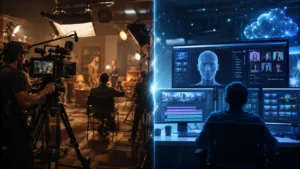
AI does not necessarily replace traditional video production. Instead, it can become part of a hybrid workflow where AI provides speed and scalability while human teams remain responsible for strategy, creativity, storytelling and quality control.
What Is AI-Powered Video Advertising?
AI-powered video advertising refers to the use of artificial intelligence to support different stages of creating, delivering and optimizing video advertisements. Depending on the workflow, AI can assist with script development, concept generation, storyboarding, visual creation, voiceovers, editing, localization, personalization and creative testing.
AI can help advertising teams produce multiple creative variations without rebuilding every element of a campaign from the beginning.
AI-Generated vs AI-Assisted Video Advertising
AI-generated video advertising can involve creating visuals, voices, scenes or other elements primarily with AI tools. AI-assisted production uses artificial intelligence to support a conventional creative workflow.
A third approach is hybrid production, which combines AI-generated elements with real footage, actors, locations, animation or conventional post-production.
This distinction is important because AI video advertising does not always mean creating an entire advertisement with AI.
For brands interested in the production side, explore our guide to AI-generated video production.
Why Is AI Becoming Important for Video Advertising?
Rising Demand for Video Content
Brands increasingly use video across Instagram, YouTube, Facebook, LinkedIn, websites and performance advertising campaigns. Each platform can require different formats, durations, messaging styles and creative approaches.
AI can help teams develop and adapt creative assets more efficiently as the volume of required content increases.
Shorter Creative Lifecycles
An advertisement that performs well initially may become less effective as audiences see the same creative repeatedly. This creates a need for new hooks, visuals, messages and calls to action.
AI can accelerate creative iteration, allowing marketers to explore more variations without starting the entire production process from scratch.
Growing Need for Personalization
Different audience segments may respond to different messages. A new prospect may need an educational message, while a returning visitor may respond better to a product benefit or offer.
AI can help create variations based on legitimate audience signals while marketers maintain control over targeting, messaging and brand standards.
Pressure to Produce More Content
Digital campaigns often require multiple versions of the same core idea. Variations may include different languages, formats, products, audiences, hooks and calls to action.
AI can make this type of creative scaling more practical.
For more examples, explore these AI video use cases for brands.
How AI Is Changing the Video Advertising Workflow
AI can influence almost every stage of the advertising workflow, from research and concept development to production, testing and optimization.
A simplified workflow looks like this:
Audience Insight → Concept → Script → Storyboard → Production → Editing → Personalization → Testing → Optimization
1. AI-Assisted Audience and Creative Research
AI can help marketers analyze large amounts of information, including audience interests, customer feedback, campaign data, search behavior and existing creative patterns.
For example, AI tools can help identify common themes in customer feedback or organize campaign performance data into useful patterns.
However, AI-generated insights still require human validation. Marketers need to determine whether a pattern is strategically meaningful and relevant to the campaign objective.
2. Faster Concept Development
Developing several advertising concepts traditionally requires considerable brainstorming and creative planning.
AI can help generate:
- Ad concepts
- Hooks
- Story angles
- Headlines
- Calls to action
- Creative directions
- Alternative messaging
The role of the creative team remains important because generating ideas is different from identifying the right idea for a specific brand and audience.
3. AI-Assisted Scriptwriting
AI can support the development of short-form advertisements, product videos, explainer ads, social media hooks and voiceover drafts.
For example, a marketer can develop several opening hooks for the same product and then select the versions that best match the audience and campaign objective.
Final scripts should always be reviewed for:
- Accuracy
- Brand voice
- Product claims
- Emotional relevance
- Clarity
- Compliance
4. AI-Generated Visuals and Pre-Visualization
AI can help creative teams visualize concepts before full production begins.
Potential applications include:
- Concept frames
- Storyboards
- Background environments
- Product scenarios
- Character concepts
- Pre-visualization
This can help teams communicate creative ideas more quickly and identify problems before investing in full production.
5. Faster Editing and Post-Production
AI-assisted tools can support several post-production tasks, including:
- Transcription
- Caption generation
- Scene selection
- Audio cleanup
- Voiceover synchronization
- Editing assistance
- Format conversion
These capabilities can reduce repetitive production work while allowing editors and creative teams to focus on storytelling and quality.
For a deeper explanation, read our guide on how AI video generation works.
AI Is Making Video Ads More Personalized
One of the biggest opportunities created by AI is the ability to develop more creative variations for different audience segments.
Audience-Based Creative
Brands can create different messaging for:
- New prospects
- Existing customers
- High-intent audiences
- Returning visitors
For example, an awareness campaign might focus on introducing a problem, while a retargeting campaign could emphasize product benefits or proof points.
Location-Based Advertising
AI can support localized versions of campaigns using different:
- Languages
- Regional messages
- Offers
- Visual references
- Voiceovers
Localization should still account for cultural context rather than simply translating the same script word-for-word.
Product-Based Personalization
Different audiences may be interested in different products or features. AI can help produce creative variations that highlight relevant products or benefits.
Funnel-Based Personalization
Video messaging can also change according to the customer journey:
Awareness → Consideration → Conversion → Retention
For more examples, explore personalized video ads.
AI and Multilingual Video Advertising
For brands operating across India and other multilingual markets, AI can make video localization more scalable.
AI-assisted workflows can support:
- Voiceovers
- Dubbing
- Subtitles
- Translation
- Regional creative variations
Depending on the campaign, brands may create versions in languages such as:
- Hindi
- English
- Tamil
- Telugu
- Bengali
- Marathi
- Kannada
- Malayalam
- Punjabi
Why Localization Is More Than Translation
Effective localization requires more than replacing words in one language with words in another.
Brands also need to consider:
- Cultural context
- Tone
- Expressions
- Audience expectations
- Regional references
- Voice and pronunciation
Human review remains important because an accurate translation may still sound unnatural or culturally inappropriate.
Learn more about AI video production services and scalable video workflows.
AI Is Changing How Brands Test Video Ads
Traditional video advertising can sometimes follow a simple model:
1 Campaign → 1 Video
AI-assisted production can make a broader testing framework possible:
1 Campaign → Multiple Hooks → Multiple Visuals → Multiple CTAs → Multiple Audience Variations
Marketers can test different elements, including:
- Hooks
- Opening three seconds
- Video length
- Visual style
- Voiceover
- Call to action
- Offer
- Product positioning
Campaign performance can then be evaluated using metrics such as:
- Click-through rate
- View-through rate
- Watch time
- Conversion rate
- Cost per acquisition
- Return on ad spend
AI can increase the number of creative variations available for testing, but marketers still need a clear testing methodology. Producing more versions does not automatically mean better performance.
Explore additional AI video use cases for brands.
The Importance of the First 3 Seconds in AI Video Ads
The opening moments of an advertisement can influence whether a viewer continues watching or scrolls past the content. This is particularly important on platforms where users quickly move between videos.
AI can help creative teams generate multiple opening concepts, but the strategy behind those hooks remains important.
Problem-Based Hook
Start with a problem that the target audience recognizes.
Curiosity Hook
Create an information gap that encourages viewers to continue watching.
Emotional Hook
Use an emotion that is relevant to the campaign and audience.
Bold Statement Hook
Present a strong, clear statement that immediately communicates the subject.
Visual Pattern Interrupt
Use an unexpected visual or transition to capture attention.
The goal should not simply be to generate more hooks. The goal is to create meaningful variations that support the campaign’s objective and brand message.
For more ideas, explore AI video for social media.
AI Video Advertising Across Different Platforms
Different platforms have different audience behaviours and creative requirements. A single master video should not simply be resized for every channel.
Instagram and Facebook
AI-assisted video workflows can support creative for:
- Reels
- Stories
- Feed advertisements
- Vertical video campaigns
Short-form content generally needs to communicate the core message quickly.
YouTube
AI can support creative development for:
- Skippable advertisements
- Shorts
- Product videos
- Long-form storytelling
The creative approach should depend on whether the campaign objective is awareness, consideration or conversion.
For B2B advertising, video can be used for:
- Product and service advertisements
- Thought leadership
- Corporate campaigns
- Explainer content
The messaging generally needs to be more focused on business problems, outcomes and credibility.
Connected TV
Connected TV can support longer-form brand storytelling and premium advertising experiences. AI can help with concept development, localization and creative variations while human production remains valuable for high-impact storytelling.
The important principle is:
Create for the platform, not just the format.
Creative should be adapted according to:
- User behaviour
- Aspect ratio
- Attention span
- Platform expectations
- Call to action
AI Video Advertising vs Traditional Video Advertising
| Factor | AI-Assisted Advertising | Traditional Production |
|---|---|---|
| Production speed | Often faster | Usually longer |
| Creative variations | Easier to scale | More resource-intensive |
| Personalization | Easier to produce at scale | Can require additional production resources |
| Physical production | Can reduce some requirements | Often requires conventional production |
| Human direction | Essential | Essential |
| Scalability | High for suitable workflows | More resource-intensive at large scale |
| Cinematic realism | Depends on tools and workflow | Strong control over real-world production |
| Best use | Digital-first campaigns and creative testing | Premium storytelling and productions requiring physical capture |
Neither approach is universally better. The right choice depends on the campaign objective, creative requirements, budget, timeline and desired level of realism.
For a deeper comparison, explore AI vs traditional video production.
What AI Still Can’t Replace in Video Advertising
AI can accelerate production, but several areas still require strong human involvement.
Strategic Thinking
AI can generate ideas, but humans need to define positioning, campaign objectives, audience priorities and business goals.
Emotional Storytelling
Effective advertising often depends on human experiences, emotions and cultural understanding. AI can assist with execution, but emotional relevance still requires creative judgment.
Brand Identity
Overusing generic AI-generated content can make different brands appear similar. Creative teams need to protect distinctive visual and verbal identities.
Creative Direction
Someone needs to decide what should actually be created, which ideas should be rejected and how the final advertisement should communicate the brand’s message.
Authenticity
Real people, real locations, real customers and genuine experiences can provide a level of authenticity that synthetic content may not always reproduce.
AI can support AI-powered brand films, but human creative direction remains important when building a distinctive brand story.
Risks and Challenges of AI Video Advertising
AI-powered advertising also introduces challenges that brands need to manage carefully.
Generic-Looking Creative
If brands rely too heavily on templates or automated generation, advertisements can lose distinctiveness.
Visual Inconsistencies
AI-generated characters, products or environments may sometimes contain inconsistencies between scenes.
Brand Safety
AI-generated content needs to be reviewed to ensure it aligns with brand standards and does not introduce inappropriate or misleading elements.
Copyright and Intellectual Property
Brands should understand the rights associated with the tools, assets, voices, music and other materials used to create advertisements.
Deepfake and Voice-Cloning Concerns
Using a person’s likeness or voice without appropriate permission can create legal, ethical and reputational risks.
Lack of Authenticity
Audiences may respond negatively when AI-generated content feels misleading or overly artificial.
AI Hallucinations
AI systems can produce incorrect information. Product specifications, claims, statistics and other factual statements should therefore be checked before publication.
Incorrect Product Representation
AI-generated visuals should not make a product appear different from what customers will actually receive.
How Brands Can Use AI Responsibly
A responsible AI video advertising workflow should include:
- Human review
- Brand guidelines
- Fact checking
- Rights management
- Consent for likeness and voice use
- Quality control
- Appropriate disclosure where required
AI should increase creative capability without compromising accuracy, trust or brand integrity.
The Future of AI-Powered Video Advertising
AI is likely to make video advertising more flexible, scalable and data-informed. However, the most effective future workflows are likely to combine AI capabilities with human creative expertise.
Hyper-Personalized Video Ads
Brands may increasingly create audience-specific creative variations based on legitimate customer and campaign signals.
Real-Time Creative Optimization
Advertising workflows may become more responsive to performance data, allowing teams to identify and develop stronger creative variations more quickly.
AI-Generated Product Environments
AI can help visualize products in different environments without requiring a physical reshoot for every creative concept.
AI + Virtual Production
AI-generated environments can be combined with real actors, physical products, cinematography and conventional production techniques.
Automated Localization
Brands can create multilingual and regional variations more efficiently while retaining human review for language and cultural accuracy.
Human + AI Hybrid Production
A likely long-term model is:
Human Strategy + Human Storytelling + AI Production Efficiency + Human Quality Control
AI is therefore more likely to become an important part of the production ecosystem than a complete replacement for every form of video advertising.
For ongoing AI video insights, explore the PulsePlay Films blog.
How Brands Can Prepare for the Future of AI Video Advertising
Start With the Advertising Objective
Before using AI, define whether the campaign is designed for:
- Awareness
- Engagement
- Leads
- Sales
- Retention
The technology should support the objective rather than become the objective itself.
Build a Creative Testing Framework
Define what you want to test, such as:
- Hooks
- Messages
- Visuals
- Calls to action
- Offers
- Video length
Testing one variable at a time where practical can make performance insights easier to interpret.
Develop Strong Brand Guidelines
Create clear guidelines covering:
- Tone
- Visual identity
- Voice
- Messaging
- Typography
- Product representation
These guidelines help maintain consistency when multiple AI-generated variations are produced.
Combine AI With Human Creative Expertise
Do not automate every creative decision. AI can accelerate execution, but creative strategy and quality control remain essential.
Measure Business Outcomes
Measure more than views and likes. Depending on the campaign, track:
- Engagement
- Click-through rate
- Conversions
- Cost per acquisition
- Return on ad spend
- Revenue
The value of AI should ultimately be evaluated by whether it helps the campaign achieve its business objectives.
Conclusion
AI is changing video advertising from a single-production model into a more continuous creative experimentation model. Instead of creating one advertisement and using it across every audience and platform, brands can increasingly develop multiple hooks, messages, formats and localized versions.
The opportunity can be summarized as:
Create More → Test More → Learn Faster → Personalize Better → Optimize Continuously
However, the winning approach is not AI vs. humans. It is AI efficiency + human creativity + strategic thinking + authentic storytelling.
Brands that combine these strengths can use AI to scale video advertising while maintaining the creative quality, accuracy and brand identity that audiences expect.
If your brand is exploring scalable AI-powered advertising content, learn more about AI-generated video services.
FAQs About AI in Video Advertising
AI is making video advertising faster and more scalable by assisting with research, concepts, scripts, visuals, editing, personalization, localization, creative testing and optimization. Human strategy and creative direction remain important for ensuring relevance, accuracy and brand consistency.
AI can generate or assist with many parts of a video advertisement, including scripts, visuals, voiceovers, editing and variations. Fully automated production is possible for some use cases, but human review is recommended for strategy, accuracy, brand alignment and quality.
AI can reduce the time and resources required for certain production tasks, particularly when creating multiple variations or digital-first content. However, costs depend on the tools, creative requirements, production quality, human involvement and campaign scope.
Yes. AI can support the creation of different video versions based on legitimate audience signals such as audience segment, location, language, product interest or funnel stage. Personalization should follow applicable privacy, consent and advertising requirements.
AI can help teams produce multiple variations of hooks, visuals, messages, CTAs and formats. These versions can then be tested using campaign metrics such as CTR, watch time, conversion rate, CPA and ROAS.
Yes. AI-assisted workflows can support translation, dubbing, subtitles and voiceover creation for different languages. Human review remains important to ensure the final content is natural, culturally appropriate and accurate.
AI is unlikely to replace every form of traditional video production. Real actors, locations, physical products, cinematography and human storytelling remain valuable for many campaigns. Hybrid workflows combining AI with conventional production are likely to become increasingly common.
Key risks include generic creative, visual inconsistencies, incorrect information, copyright issues, unauthorized voice or likeness use, brand-safety concerns and misleading product representation. Human review and appropriate rights management can reduce these risks.
The future is likely to involve greater creative scalability, personalization, localization and performance-based optimization. AI may become more deeply integrated into production workflows while human teams continue to control strategy, storytelling, creative direction and quality.
The choice depends on the campaign. Fully AI-generated content may suit certain digital-first campaigns and creative experiments, while hybrid production can be more appropriate when brands need real people, physical products, authentic locations or a high degree of creative control.